solucion
dsolve({(diff(y(x), x))/y(x)^2 = -e^cos(x)*sin(x)});
print(`output redirected...`); # input placeholder
                               ln(e)
                  |y(x) = -------------------
                                      cos(x)
                         _C1 ln(e) - e
dsolve({(diff(y(x), x))/y(x)^2 = -e^cos(x)*sin(x)}); print(`output redirected...`); # input placeholder ln(e) |y(x) = ------------------- cos(x) _C1 ln(e) - e
function lotecomplejo
[t,x]=ode45(@lote,[0 2],[16 0 0 0])
subplot(4,1,1); plot(t,x(:,1))
subplot(4,1,2); plot(t,x(:,2))
subplot(4,1,3); plot(t,x(:,3))
subplot(4,1,4); plot(t,x(:,4))


function dx=lote(t,x)

% definicion de parametros

k1=5;
k2=4;
k3=3;
k4=3;

dx=zeros(4,1);

% ecuaciones de diseño (balances de masa), x1 = Ca, x2 = Cb, x3 = Cc, x4 = Cd

dx(1) = - k1*x(1);
dx(2) = k1*x(1) - k2*x(2) + k3*x(3) - k4*x(2);
dx(3) = k2*x(2) - k3*x(3);
dx(4) = k4*x(2);
function []=regu_fal(x1, x2, n);

fx1=f(x1);
fx2=f(x2);
c = x2 - ((f(x2)*(x2-x1))/(f(x2) - f(x1)))
fc=f(c)
if fx1*fx2<0;
     for i=1:n
     if fc<0
        x1=c;
        fx1=f(x1);
        c = x1 - (fx1*(x1-x2)/(fx1-fx2))
        fc = f(c)
       else
          x2=c;
          fx2=f(x2);
          c = x2 - (fx2*(x2-x1)/(fx2-fx1))
          fc = f(c)
      end
    end
else
    disp('Error en los Valores X1, X2');
end
end
function fx = f(x);
	fx = x^3-9*x+1;  %% puedes cambiar por la funcion que gustes
	return;
#include<stdio.h>
#include<conio.h>
#include<math.h>
#include<process.h>
#include<string.h>

void main(){
 int n;
 int i,j;
 float ax[10];
 float ay[10];
 float y=0;
 float x;
 float h;
 float p;
 float diff[20][20];
 float y1,y2,y3,y4;

 printf("\n Numero de Terminos: ");
 scanf("%d",&n);
 printf("\n\n Valor de X: ");
 for(i=0;i<n;i++){
  printf("\n\n Valor de x%d: ",i+1);
  scanf("%f",ax[i]);

 }

  printf("\n\n Valor de Y: ");
 for(j=0;j<n;j++){
  printf("\n\n Valor de y%d: ",i+1);
  scanf("%f",ay[i]);

 }
printf("\n Valor para x: ");
printf("\n Valor para y: ");
scanf("%f",&x);
 h = ax[1]-ax[0];
  for(i=0;i<n-1;i++){
   diff[i][1]=ay[i+1]-ay[i];
  }
   for(j=2;j<=4;j++){
    for(i=0;i<n-j;i++){
     diff[i][j]=diff[i+1][j-1]-diff[i][j-1];
    }
   }
   i=0;
    do{
     i++;
    }while(ax[i]<x);
    i--;
    p=(x-ax[i])/h;
    y1= p*diff[i-1][1];
    y2=p*(p+1)*diff[i-1][2]/2;
    y3=(p+1)*p*(p-1)*diff[i-2][3]/6;
    y4 = (p+2)*(p+1)*p*(p-1)*diff[i-3][4]/24;
    y =ay[i]+y1+y2+y3+y4;

      printf(" x= %6.4f, y= 6.4%f ",x,y);
      printf("\n\n\n Enter para Salir");
      getch();
}
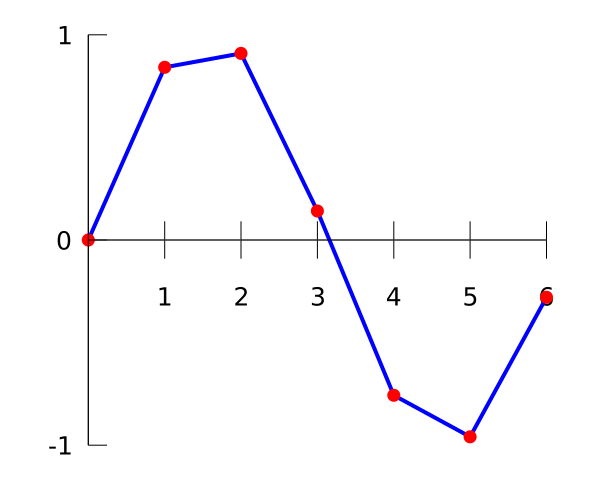
#include<stdio.h>
#include<string.h>
#include<conio.h>
#include<math.h>
#include<process.h>

#define f(x) 3*x -cos(x) -1
#define df(x) 3 -sin(x)

void nwrap();

void main(){
 printf("\n Solucion por el Método de Newton Raphson \n");
 printf("\n F(x): ");
 printf("\n\t\t\t 3*x -cos(x) -1 = 0 \n\t");
 nwrap();
 getch();
}

void nwrap(){
 float x1,x0;
 float f1,f0;
 float df0;
 int i=0, itr=0;
 float TOL;
 float error;
   for(x1=0;;x1 +=0.01){
    f1=f(x1);
    if (f1>0){
     break;
    }
   }
x0 = x1-0.01;
f0 = f(x0);
printf("Numero de Iteraciones: ");
scanf("%d",&itr);
printf("Tolerancia Maxima: ");
scanf("%f",&TOL);
     if(fabs(f0)>f1){
      printf("\n\t\t La raiz es: %0.4f\n",x1);
     }
     if(f1 > fabs(f(x0))){
      printf("\n\t\t La raiz es: %0.4f\n",x1);
 }
x0 = (x0+x1)/2;
for(;i<=itr;i++){
 f0=f(x0);
 df0=df(x0);
 x1 = x0 - (f0/df0);
 printf("\n\t\t iteracion %d  aproximacion: %f",i,x1);
 error = fabs(x1-x0);
   if(error < TOL){
    break;
   }
 x0 = x1;
}
   if(error > TOL){
    printf("\n\n\t Iteraciones No suficientes" );
   }
printf("\n\n\n\t\t\t--------------------------");
printf("\n\n\t\t Raiz: %0.4f ",x1);
printf("\n\n\n\t\t\t--------------------------");
}

# include <stdio.h>
# include <math.h>
# include<conio.h>
# include<string.h>
# include<process.h>
#define TOL 0.000005
#define f(x) 3*x+sin(x)-exp(x)

void falsaposicion();

void main() {
	printf("\n Solucion por el metodo de Falsa posicion \n");
	printf("\n La Ecuacion a resolver es: ");
	printf("\n\t\t\t 3*x+sin(x)-exp(x)= 0 \n\n");
falsaposicion();
}

void falsaposicion(){
	float f0,f1,f2;
	float x0,x1,x2;
	int itr;
	int i;
	printf("Numero Maximo de Iteracciones: ");
	scanf("%d",&itr);
	for(x1=0.0;;){
		f1=f(x1);
		if (f1>0){
			break;
		}
		 else {
		 	x1 = x1+0.1;
		 }
	}

	x0= x1-0.1;
	f0 = f(x0);
	printf("\n\t\t----------------------------------------");
	printf("\n\t\t Iteraccion\t x\t\t F(X) \n");
	printf("\n\t\t----------------------------------------");
	  for(i=0;i<itr;i++){
	  	x2 = x0-((x1-x0)/(f1-f0))*f0;
	  	f2=f(x2);
	  	 if(f0*f2>0){
	  	 	x1=x2;
	  	 	f1=f2;
	  	 }
	  	   else {
	  	    	x0=x2;
	  	    	f0=f2;
	  	   }
	  	     if (fabs(f(2))>TOL){
	  	     	printf("\n\t\t%d\t%f\t%f\n",i+1,x2,f2);
	  	     }
	  }
	  printf("\t\t--------------------------------");
	  printf("\n\t\t\t Raiz= %f\n",x2);
	  printf("\t\t------------------------------");
	  getch();
			}
Ejecutando:# include<stdio.h> # include<conio.h> # include<math.h> # include<process.h> # include<string.h> # define TOL 0.000001 # define F(x) (x)*log10(x) - 1.2 void Bisect(); int i=1, n; float raiz = 1; void main(){ printf("\n Solucion por el Metodo de Biseccion \n"); printf ("\n La ecuacion es: "); printf("\n\t\t\t (x)*log10x) -1.2 = 0 \n\n"); printf("Numero Maximo de Iteracciones: "); scanf ("%d",&n); Bisect(); } void Bisect(){ float x1,x2,x0; float f0,f1,f2; int j=0; for (x2=1;;x2++){ f2 = F(x2); if(f2 >0){ break; } } for (x1=x2-1;;x2--){ f1 = F(x1); if(f1<0){ break; } } printf ("\t\t------------------------------------\t\t"); printf ("\n\t\t Iteracion Raiz \n"); printf("\t\t-------------------------------------\t\t"); for (;i<=n;i++){ x0 = (x1+x2)/2.0; f0 = F(x0); if (f0==0){ raiz = x0; } if(f0*f1<0){ x2=x0; } else{ x1 = x0; f1= f0; } printf("\n\t\t Iteracion %d ", i); printf("\t :\t %f", x0); if(fabs((x1-x2)/x1) < TOL ){ printf("\n\t\t ------------------------------------"); printf("\n\t\t Raiz = %f",x0); printf("\n\t\t Iteracion = %d\n",i); printf("\t\t-------------------------------------"); getch(); exit(0); } } printf("\n\t\t---------------------------------------"); printf("\n\t\t\t Raiz = %7.5f",x0); printf("\n\t\t\t Iteracion = %d\n", i-1); printf("\t\t-----------------------------------------"); getch(); }


